
Drafty Windows? Cellular Shades vs. Interior Shutters
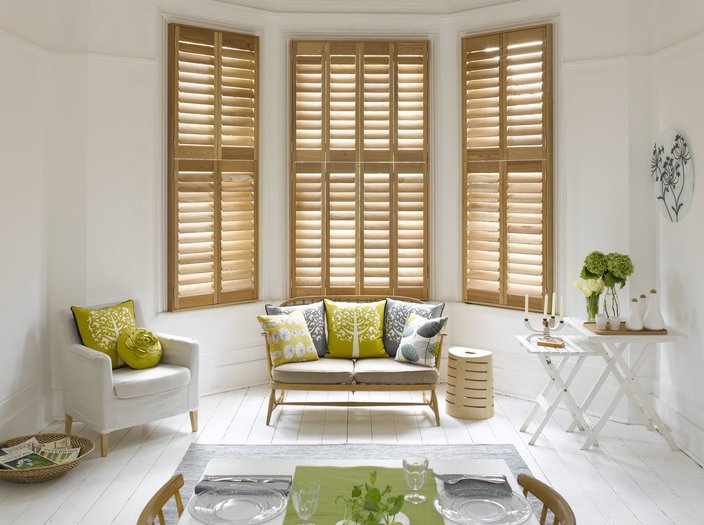
While replacing whole window assemblies costs thousands, custom insulating treatments deliver immediate draft control, balance room temperatures, and noticeably reduce utility bills.
Two treatments dominate energy efficiency: Cellular (Honeycomb) Shades and Solid Composite Shutters. Here is how they stack up against cold drafts.
How Cellular Shades Eliminate Drafts: The Honeycomb Barrier
Cellular shades were engineered specifically as energy-saving treatments during the 1970s energy crisis, and they remain the highest-rated fabric window covering for thermal insulation.
- The Trapped-Air Principle: Unlike single-sheet fabrics, hollow accordion pockets capture stationary air, creating an insulating thermal break between chilled window glass and your room.
- Single-Cell vs. Double-Cell: Double-cell options add a second layer of honeycomb barriers, significantly raising the overall R-value.
- Foil & Metallized Backing: Blackout thermal backings prevent radiant heat transfer entirely, delivering near-total temperature barrier performance.
- Side Track Channels: Pairing cellular fabrics with snap-in side tracks eliminates edge gaps, sealing drafts that standard shades leave behind.
How Interior Shutters Stop Air Leaks: The Solid Barrier
Plantation shutters and solid interior wood or composite shutters act as an architectural layer attached directly to the window jamb.
- Structural Barrier: Unlike fabric, a closed wooden or polyresin shutter louver is a solid physical obstacle against moving air.
- Frame Sealing: Shutters are mounted inside a dedicated frame (L-frame or Z-frame) screwed tightly against your window trim. This tight fit dramatically limits air convection along the borders of the window opening.
- Composite & Polycore Density: While real wood offers natural insulation, high-density composite or PVC shutters offer dense cores that resist air penetration and will not warp or crack when exposed to window moisture or condensation.
Thermal Performance: Cellular Shades vs. Shutters Head-to-Head
| Feature | Double-Cell Cellular Shades | Solid / Composite Shutters |
|---|---|---|
| Primary Insulation | Trapped dead-air barrier (cells) | Rigid thermal wall + frame seal |
| Draft Reduction | Exceptional (Up to 40% reduction) | High (Blocks direct airflow) |
| R-Value Boost | R-2.0 to R-4.5+ (Fabric dependent) | R-2.5 to R-3.5+ (Material dependent) |
| Edge Sealing | Requires side tracks for 100% seal | Built-in frame naturally seals edges |
| Aesthetic Style | Clean, minimalist, modern profile | Classic, permanent architectural value |
| Light & View Control | All-or-nothing (or top-down/bottom-up) | Tilting louvers offer precision control |
| Longevity | 7–12 years depending on usage | 20+ years; permanent home fixture |
Which Solution Should You Choose?
Choose Cellular Shades If:
- Maximum R-value is priority #1: Double-cell fabrics with side tracks offer the highest thermal reduction.
- You want a minimalist look: They stack ultra-tight when raised, maximizing solar heat gain on winter afternoons.
- You have specialty shapes: Hexagonal fabrics adapt well to skylights, angled tops, and large picture windows.
Choose Interior Shutters If:
- You want long-term value: Shutters add permanent architectural appraisal equity to your home.
- You want light & draft control together: Tilt louvers upward for daylight while keeping the frame sealed against wind.
- Moisture is present: High-density poly shutters resist glass sweat and condensation without rotting or peeling.
Eliminate Drafts with Custom Measuring & Installation
A draft-stopping window treatment is only as effective as its installation fit. Even a quarter-inch factory margin allows draft currents to leak through. At Blind Ambition, we measure, engineer, and professionally mount custom shades and shutters for an airtight seal.
Schedule Your Free In-Home Consultation